AI-native engineering lead

Aleksei Nikolaev

AI-native engineering lead · production agent systems · fintech backend

Agents write the code. The ghost decides what is true.

I build LLM systems you can trust with money and legal answers: every citation and every figure is verified by code before a human sees it. And I build the process where orchestrated agents write most of the code — under an architecture, a test suite and an adversarial audit by a second model.

art: winecrow
art: winecrow
  • 12public stands, live
  • 3,562tests across their repos
  • $0.001typical cost per answer
  • 2005first commercial code

01

Ghost and shell

The Ghost in the Shell metaphor describes the method literally. The shell is the execution layer: agents, tools, stands, CI. The ghost is judgement: what to build, which invariants to hold, what counts as true.

Ghost

  • Architecture and boundaries: what to split, where sync, where async, where the money is
  • Invariants in code: idempotency, double-entry, a reconciliation equation that must close
  • Acceptance criteria before the first line — and acceptance against them, not “tests are green”
  • Ownership: what ships is what I signed

Shell

  • Orchestrated agents write most of the code and tests
  • A second model plays adversary: an independent audit of every stand
  • Validators: citations, numbers, hashes, addresses — checked against data by code
  • Economics on display: tokens, cache, price — under every answer
Question Agent Tools Validator Answer refusal
Question → agent → tools → validator → answer. If it doesn’t match the data, you get a refusal — not a plausible fabrication.

02

Stands

A public lab: each stand is a real business problem taken to production with its own tests, price tag and stated limits. Open them and ask — these are live services, not videos.

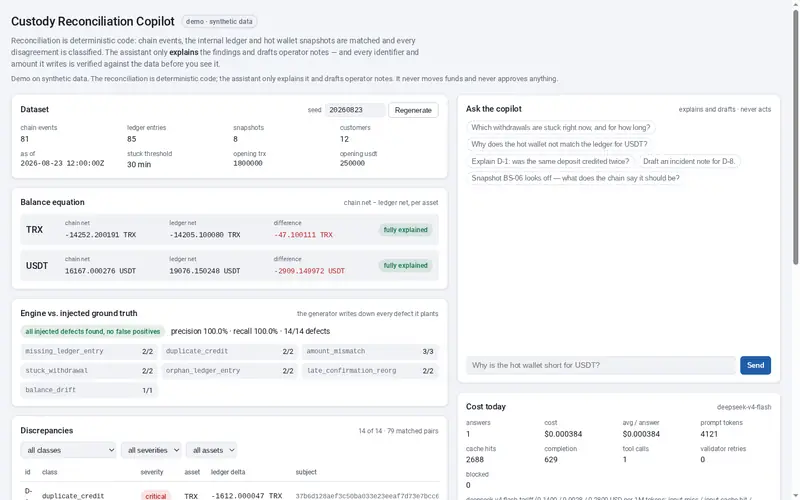
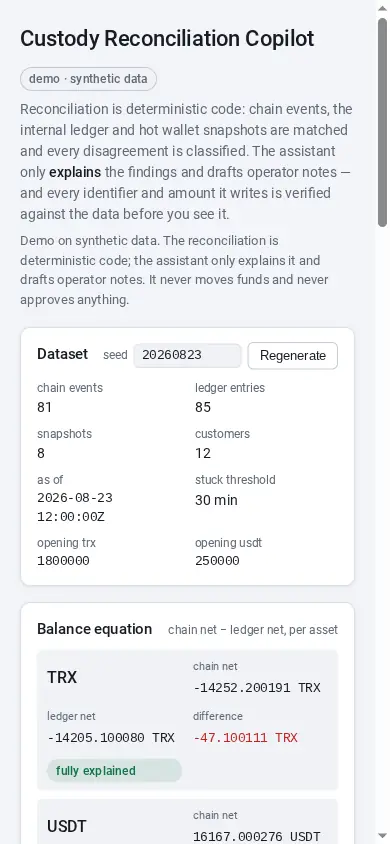
Screenshot of the “Custody Reconciliation Copilot” stand
Money & reconciliationEN

Custody Reconciliation Copilot

Problem

The chain says one thing, the internal ledger another — and someone has to find out which is wrong before the shift ends.

How

Reconciliation is deterministic code: chain events matched against double-entry journals and wallet snapshots, seven discrepancy classes, a balance equation that must close per asset. The model only explains — and every figure, hash and address in its answer is checked against the data before anyone sees it.

Proof
  • 621 tests
  • precision/recall 1.0 across 7 seeds
  • ≈ $0.001 per answer
  • integer minor units, no floats
built 2026-08-23 · in 1 hOpen
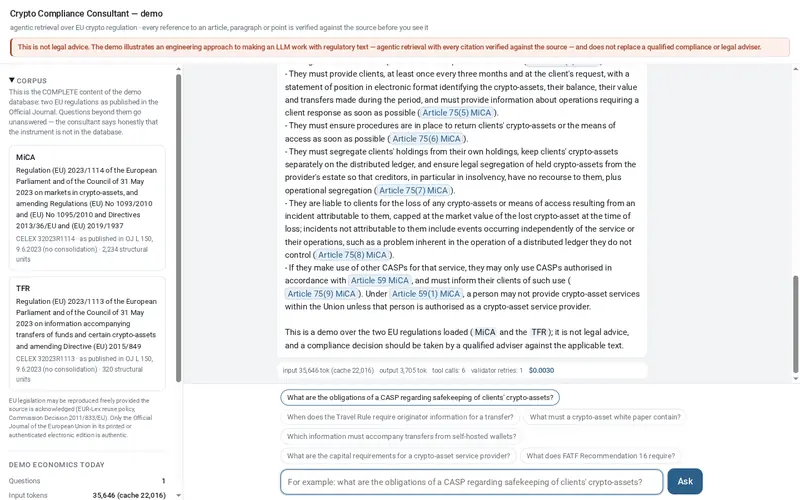
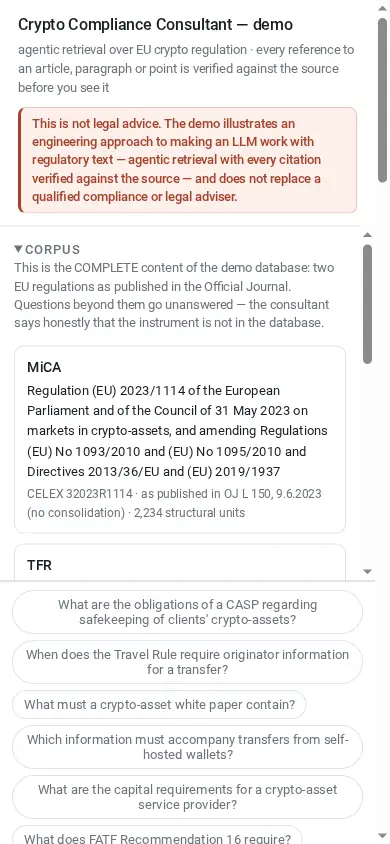
Screenshot of the “Crypto Compliance Consultant — MiCA & EU Travel Rule” stand
Regulatory & legal RAGEN

Crypto Compliance Consultant — MiCA & EU Travel Rule

Problem

A compliance question on EU regulation needs an answer with the exact article — not a confident guess.

How

The agent walks the structure of the acts (article → paragraph → point, cross-references) instead of similar-looking chunks. Every citation is verified by code against the corpus; if it fails, you get a refusal, not an invention. Each answer shows its cost.

Proof
  • 2 regulations, 2,554 addressable units
  • 455 tests
  • citation validator is code, not a prompt
built 2026-08-23 · in 1 hOpen
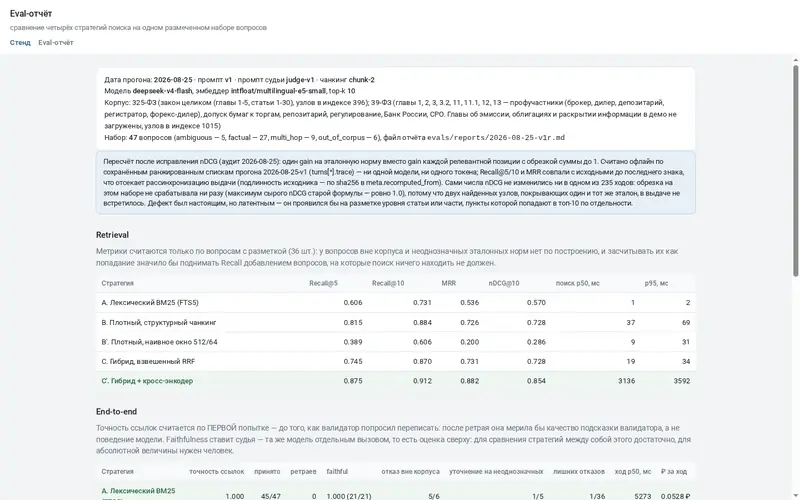
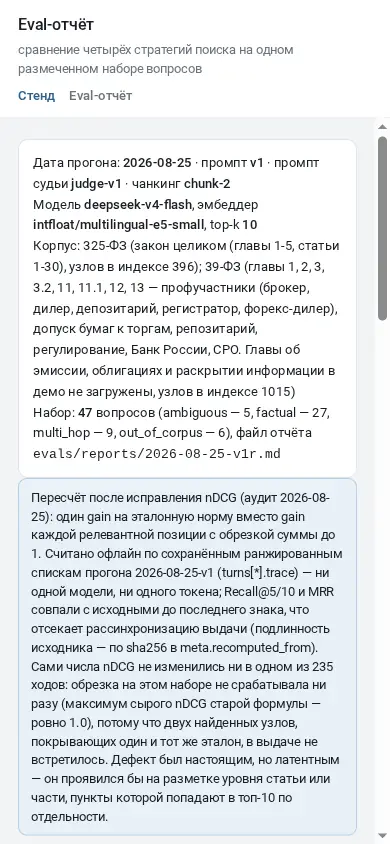
Screenshot of the “RAG bench with an evaluation loop” stand
Regulatory & legal RAGRU

RAG bench with an evaluation loop

Problem

“We have RAG” means nothing until you measure which retrieval actually works on your corpus.

How

Five strategies on one corpus (lexical, dense with two chunkings, hybrid, hybrid + cross-encoder), 47 labelled questions, Recall/MRR/nDCG, judge-scored faithfulness, cost and latency — reproducible, prompt-versioned. Results shown as they are, including the inconvenient ones.

Proof
  • Recall@10: 0.61 naive windows → 0.91 hybrid + reranker
  • 363 tests
  • the first hybrid lost — the cause was found and written up
built 2026-08-25 · in 7 hOpen
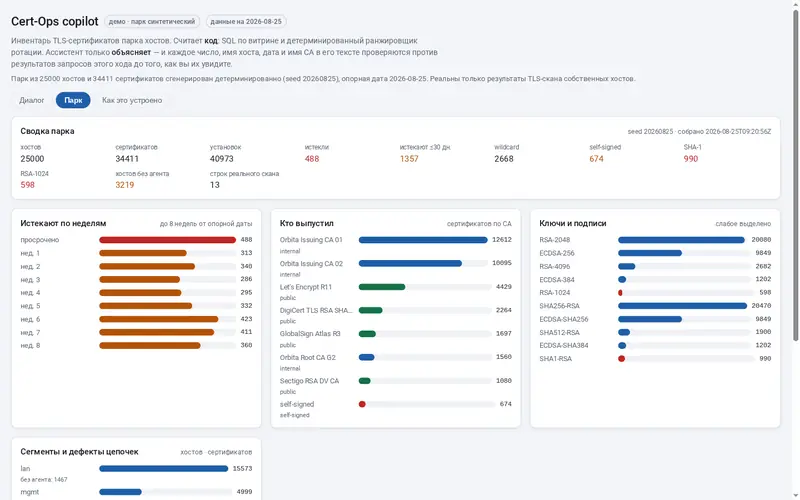
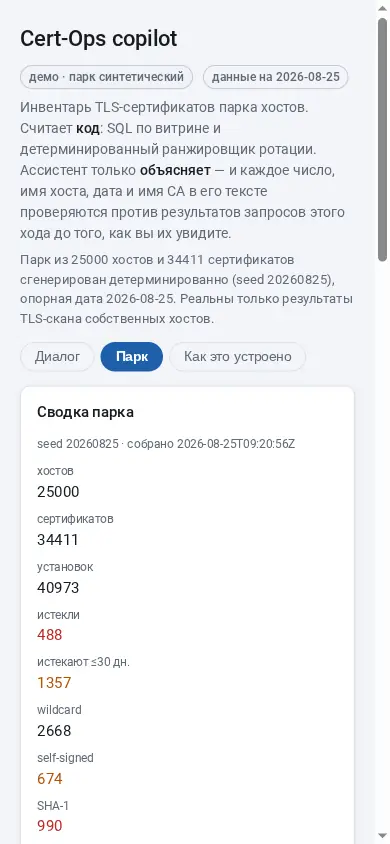
Screenshot of the “Cert-Ops copilot — TLS/PKI inventory for 25,000 hosts” stand
InfrastructureRU

Cert-Ops copilot — TLS/PKI inventory for 25,000 hosts

Problem

“What expires in 14 days in the DMZ, and where else does this CA live?” — ops questions that must not be answered approximately.

How

Go, a single static binary. The agent writes guarded SQL, builds a rotation plan with a deterministic ranker, scans real hosts from a whitelist. Every number, hostname and CA in the answer is checked against the query result; an unrecognised number form blocks the answer. ADRs and C4 in the repo.

Proof
  • 135 tests; 7 findings from an adversarial audit closed the same day
  • ≈ $0.0007 per answer
  • from spec to public stand in 5 hours
built 2026-08-25 · in 5 hOpen
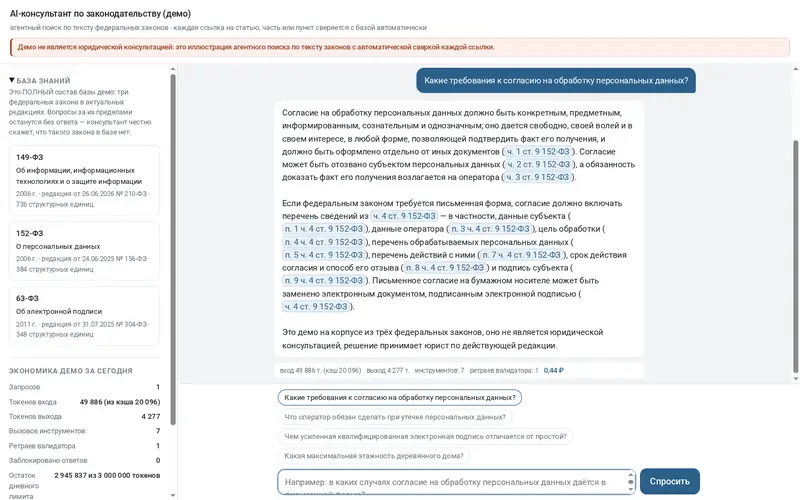
Screenshot of the “Legal consultant over federal law” stand
Regulatory & legal RAGRU

Legal consultant over federal law

Problem

A legal answer without a verifiable reference to the norm is a liability, not help.

How

Structural retrieval over articles/parts/points of three federal laws; every reference is code-validated and clickable — it opens the actual text of the norm. Each answer shows its cost in tokens and money.

Proof
  • 588 tests
  • citations only from nodes the agent actually opened
  • daily cost dashboard
built 2026-08-06 · in 6 hOpen
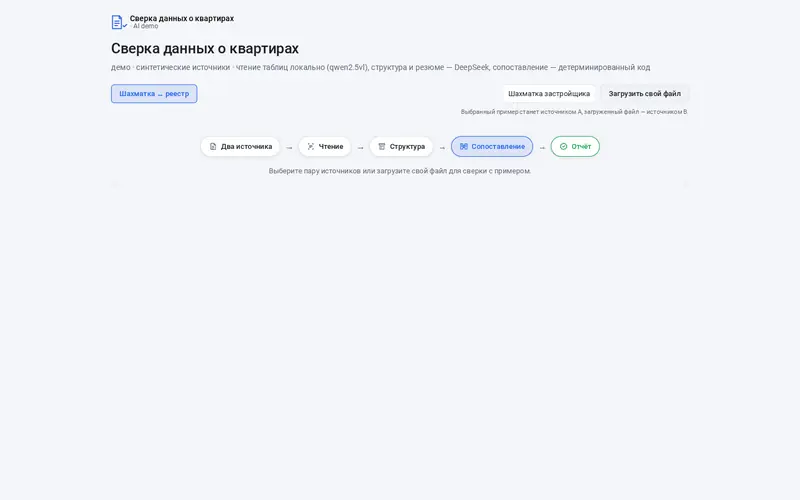
Screenshot of the “Reconciling apartments from two dirty sources” stand
DocumentsRU

Reconciling apartments from two dirty sources

Problem

A developer’s floor chart (an image) and a registry export (a PDF) describe the same apartments differently. One trustworthy list is needed.

How

Four visible stages: OCR → LLM extraction → grounding check of every record against the source → deterministic matching. A model error shows up at its own stage, not in the final table.

Proof
  • 321 tests
  • local OCR (Qwen-VL on own GPU) — documents never leave the machine
  • every record flagged: grounded / not
built 2026-08-05 · in 8 hOpen
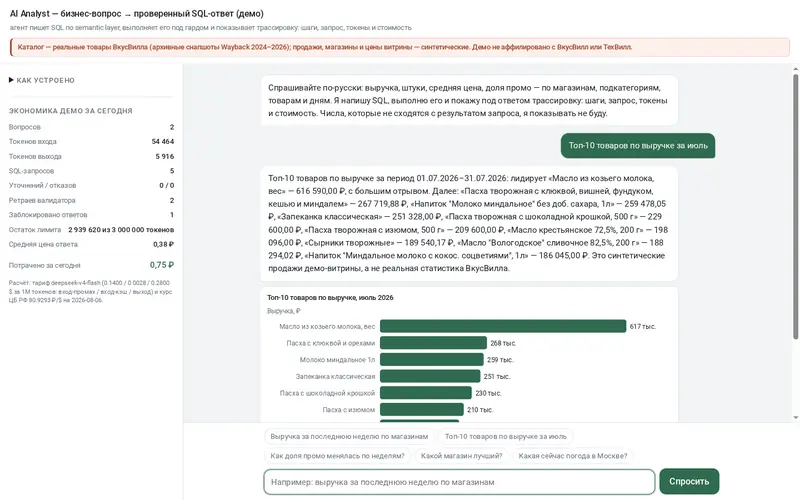
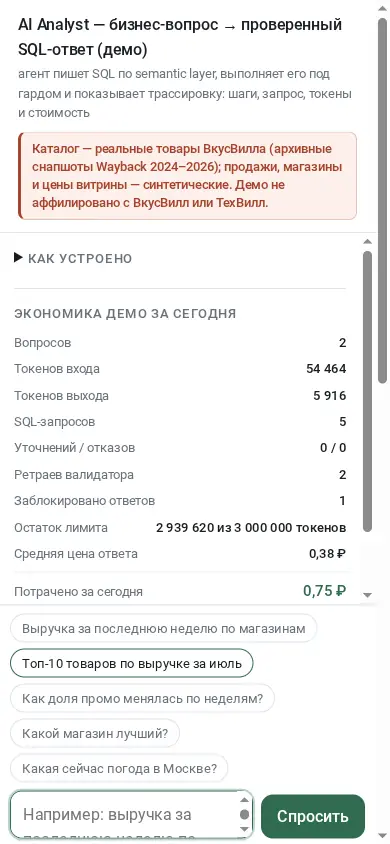
Screenshot of the “AI Analyst: business question → verified SQL” stand
AnalyticsRU

AI Analyst: business question → verified SQL

Problem

The analyst is busy and the business needs “which category dropped during the promo” now — without confident nonsense.

How

The agent reads a semantic layer, writes AST-guarded SQL, asks a clarifying question when the request is ambiguous, refuses outside the domain. Every number in the answer must appear in the query result. Full trace: steps, SQL, tokens, cost.

Proof
  • 120 tests
  • eval set with traps: ambiguous → clarify, off-domain → refuse
  • real catalogue + synthetic sales, labelled as such
built 2026-08-11 · in 8 hOpen
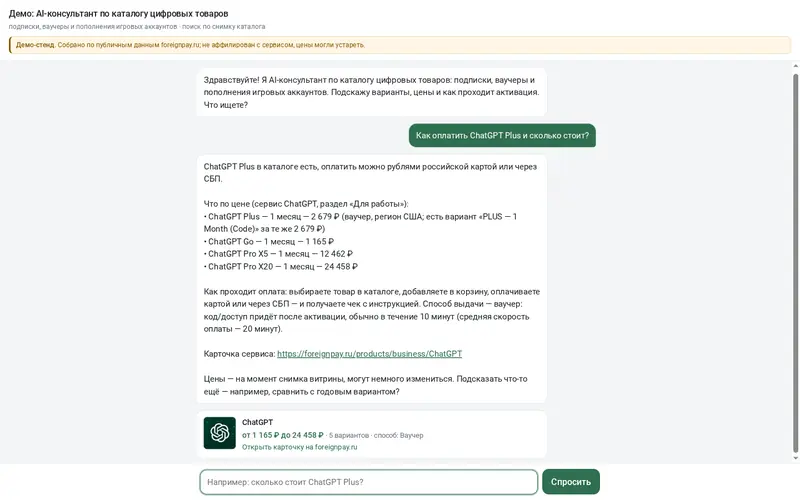
Screenshot of the “Digital-goods catalogue assistant” stand
Catalogs & salesRU

Digital-goods catalogue assistant

Problem

A shopper asks “which subscription tier fits” — and the answer must come only from the real catalogue, at the real price.

How

Function calling over a structured index (~300 items, all denominations) instead of free generation: the agent cannot name a product or price that does not exist. Quotas and a token budget built in.

Proof
  • idea to public production in one day
  • 211 tests
  • zero invented products, by construction
built 2026-08-13 · in 1 hOpen
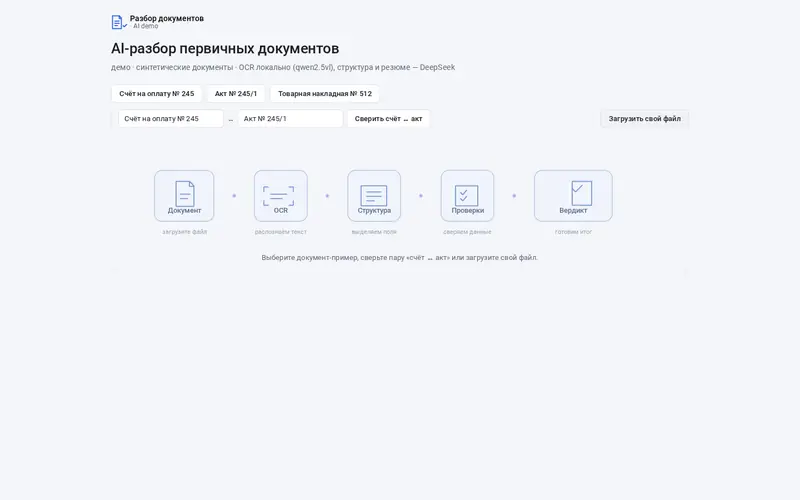
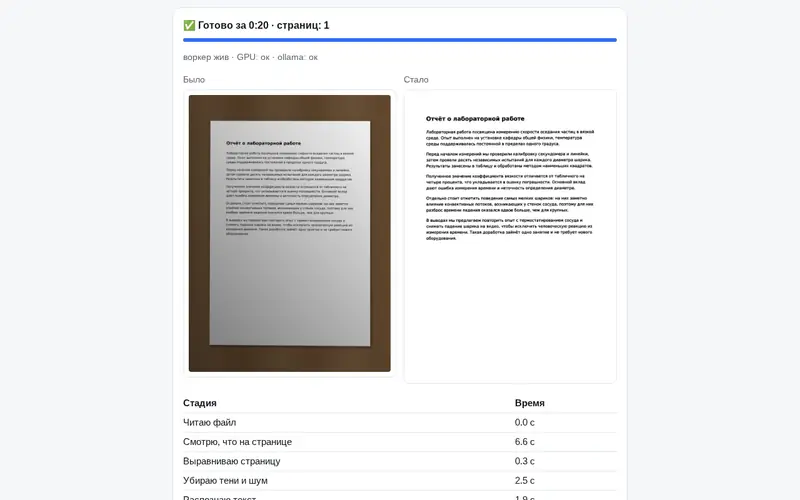
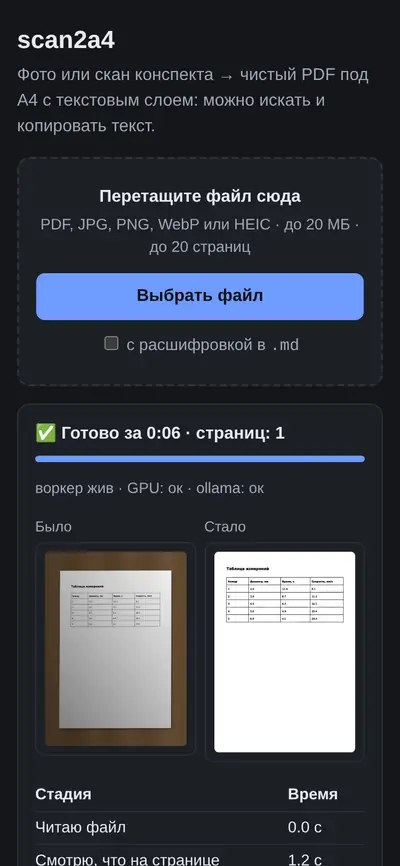
Screenshot of the “Primary-document intake” stand
DocumentsRU

Primary-document intake

Problem

Invoices and delivery notes arrive as images. They must become verified requisites, not “roughly this”.

How

OCR → structure → code checks of requisites (tax IDs, totals, dates, cross-sums) → verdict; each stage shows its own output.

Proof
  • 282 tests
  • local vision model, no cloud
  • you can see exactly where the model went wrong
built 2026-08-03 · in 8 hOpen
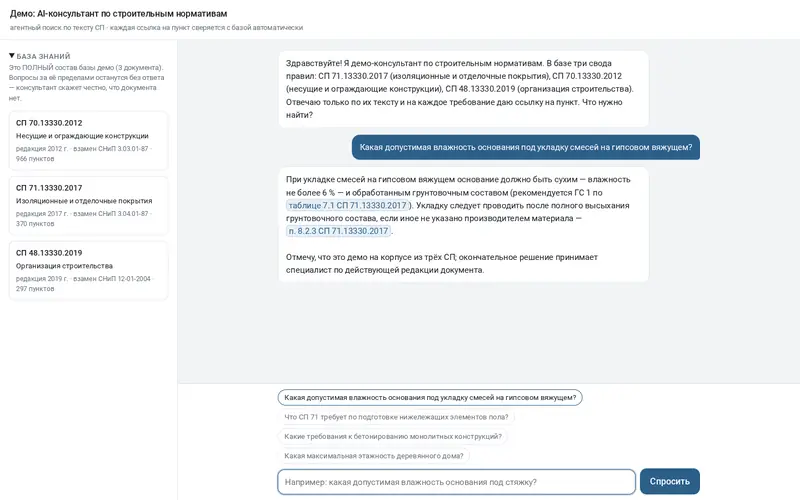
Screenshot of the “Building-codes consultant” stand
Regulatory & legal RAGRU

Building-codes consultant

Problem

An engineer needs the clause, not a paraphrase.

How

Same principle as the legal stands: agentic retrieval over document structure, deterministic check of every reference, click opens the source clause.

Proof
  • 313 tests
  • a reference the corpus cannot confirm means the answer is withheld
built 2026-08-03 · in 6 hOpen
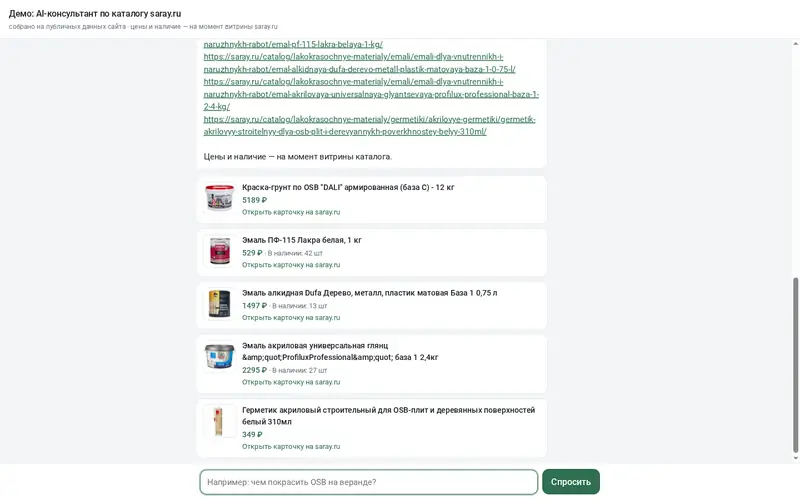
Screenshot of the “Hardware-store catalogue assistant” stand
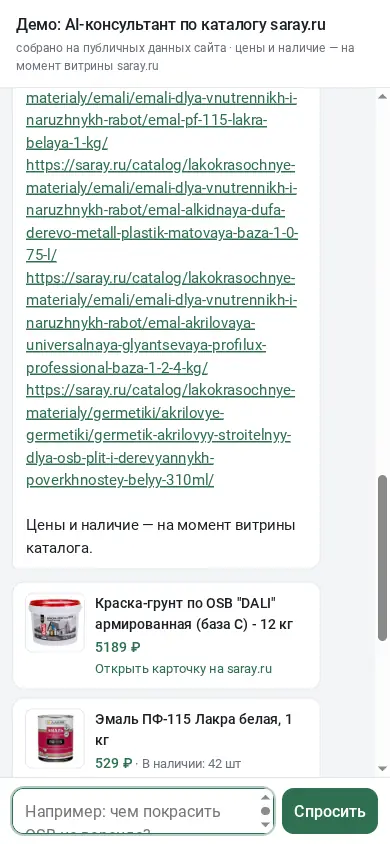
Catalogs & salesRU

Hardware-store catalogue assistant

Problem

15,000 SKUs; the customer describes a task in words (“what to paint outdoor OSB with”), not an article number.

How

An agent with search tools over a local catalogue index and FAQ, hand-off to a manager for leads; polite harvesting of public data respecting robots.txt.

Proof
  • 15,562 products, 738 categories
  • 153 tests
  • the first stand of the line
built 2026-07-28 · in 16 hOpen
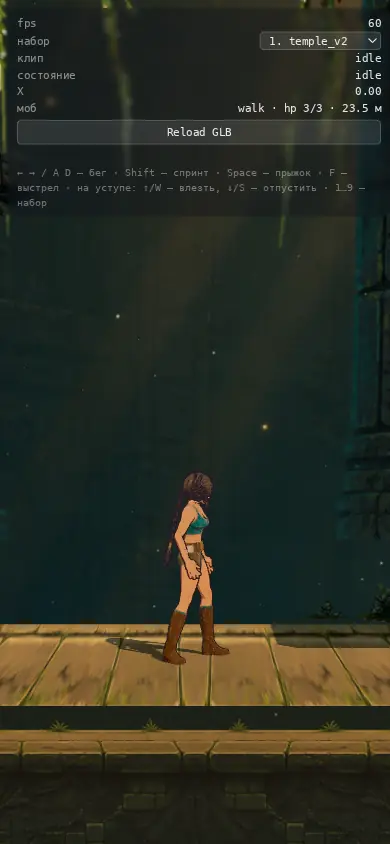
Screenshot of the “2.5D platformer: characters and animation built with agents” stand
PlayEN

2.5D platformer: characters and animation built with agents

Problem

A test on different material: a character pipeline (passport, hair, physics, MToon export) and a playable scene — can agents carry this too.

How

Three.js; assets and animation produced by an agent pipeline under review; for the lab — a playground for generation experiments.

Proof
  • playable in the browser
  • a bridge to the gaming domain in outreach
built 2026-08-12Open

03

How it is made

Five rules that repeat in every stand and in the exchange’s production code.

01

Contract first

A design document with acceptance criteria is written before any code. The agent gets a contract, not “make it nice”. Acceptance is by the criteria — diff, tests, a live run.

DESIGN → criteria → code → acceptance

02

The LLM is not a source of facts

The model searches, reasons and explains. Truth is established by code: a citation validator, number grounding, a deterministic reconciliation engine. Unconfirmed — an honest refusal.

demo10: a citation to a non-existent paragraph never reaches the user

03

Quality is a number

Evals on a labelled set, precision/recall against ground truth, mutation tests so that a green suite means something.

demo12: five retrieval strategies, Recall@10 from 0.61 to 0.91

04

A second model plays adversary

Before publication an independent model audits the stand with the brief “find a way around it”. Findings are closed with tests, not promises.

demo13: 7 findings in an hour — quota bypass, numbers slipping past the validator, DNS rebinding — closed the same day

05

Economics on display

Under every answer: tokens, cache share, price. A daily budget, per-session quotas. AI cost is part of the product, not a surprise at month end.

an answer on demo11 ≈ $0.001; a day of the stand costs less than a coffee

One day, one stand

What the pace looks like: demo13 from a job post to a public service, 25 August 2026.

  1. 12:47Design doc: problem, data, invariants, acceptance criteria
  2. 13:30Agent: a 25,000-host inventory generator, SQL guard, grounding validator
  3. 16:49103 tests green, static binary, live smoke run
  4. 17:00Adversarial audit by a second model: 7 findings
  5. 17:35Findings closed, 135 tests, redeploy
  6. 17:45Link to the stand — in the letter to the employer

04

Track record

Not a list of titles — four episodes I am personally accountable for.

An exchange’s custody contour

Replaced a third-party custody provider with an in-house contour: full TRON node, signer, double-entry ledger, on-chain ↔ ledger reconciliation, anti-fraud limits. Migrated without stopping the business. Java 21/25, Micronaut, Kafka, PostgreSQL.

An AML graph on a full node

Chainalysis cost as much as a department. Built our own transaction graph on top of the node: address clustering, flow tracing, risk scoring — as an internal compliance service.

An AI-native process for the team

Moved development onto orchestrated agents: documentation as a context graph, AI review in CI, evals in the pipeline. After the team was cut in half, release cadence held.

The lab, 2025–2026

12 public stands, “Artel” — an agent team that builds software from a contract, and a claim-store semantic memory for agents. All on my own infrastructure, testing my own hypotheses.

art: winecrow
art: winecrow

Timeline

  • 2023 — nowAWX, crypto exchange — Lead Backend / AI Lead
  • 2011 — 2026SimSite — founder, principal engineer; integrations for businesses and a university
  • 2018 — 2021University of KwaZulu-Natal, South Africa — postdoc, theoretical physics
  • 2016PhD, theoretical physics (RUDN University)
  • 2014Heidelberg University, ZAH — research trainee, Russian President’s scholarship
  • 2011Degrees: physics & informatics; economics (financial management)

Stack

Java (Micronaut, GraalVM native) · Kotlin · Python (FastAPI) · Go · TypeScript · Dart/Flutter · Perl · PostgreSQL · Kafka/Redpanda · Docker/Swarm · GitLab CI · Linux · LLM agents & orchestration · grounded RAG · MCP · evals · local inference (Ollama, Qwen, Whisper)

Languages

Russian — native · English — professional (3 years in South Africa, a year in Germany) · German — basic

05

Science

The same discipline as in code: a claim without verification does not get published.

  • 01Universal cosmological solutions in Lovelock gravity — Eur. Phys. J. C 85, 25 (2025), sole author
  • 02Embedding with Vaidya geometry — Eur. Phys. J. C (2020), with S. D. Maharaj
  • 03Kinetic scalar curvature extended f(R) gravity — Nucl. Phys. B (2018)

ORCID 0000-0003-2730-8470≈15 publications; talks at GR22 (Valencia), BRICS AGAC, SAMS congresses

06

Get in touch

Remote from Russia; open to extended on-site stints and relocation on the right terms. I reply within a day.